The CTO’s Dashboard: 5 Quality Metrics That Actually Drive Engineering Velocity
Stop tracking vanity metrics. Here are the 5 essential quality KPIs every CTO and Engineering VP must monitor to balance speed, stability, and scale. Learn how to turn QA into a growth engine.
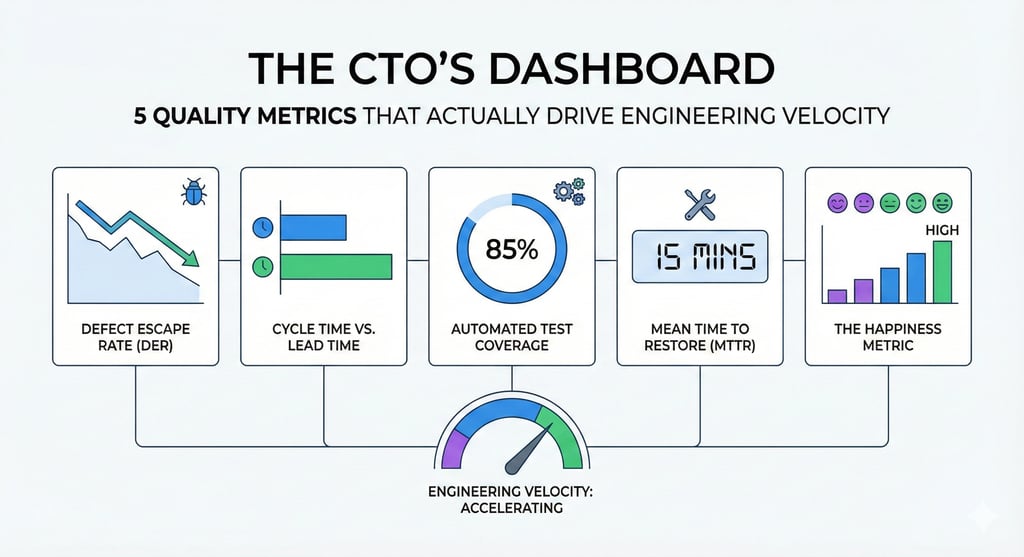
Table of Contents
Moving Beyond "Pass Rates": A Mindset Shift
In the early days of a startup, "Quality Assurance" often looks like the founder clicking through the app before a demo. But as you scale, adding microservices, expanding the team, and pushing daily deployments, intuition is no longer a strategy.
Many engineering leaders fall into the trap of "Vanity QA." They track the number of test cases executed or the raw count of bugs found. While these numbers look good on a slide deck, they don't tell you the health of your product. In fact, a 100% pass rate on a stagnant test suite often hides a fragile system.
Real engineering velocity requires a dashboard that measures confidence. We need metrics that answer one question: How fast can we ship value without breaking the user experience?
The best engineering organizations, from nimble startups to tech giants, view quality not as a gatekeeper, but as an accelerator. When you measure the right things, you empower your developers to move faster.
Metric 1: Defect Escape Rate (DER)
What it is:
The percentage of defects found by your customers (in production) versus those found by your team (in development/QA).
Why it matters to a CTO:
This is your "Reputation Metric." A high DER means your safety net has holes. It is significantly more expensive, both financially and reputationally, to fix a bug after it has been deployed.
The Healthy Approach:
Don't aim for zero bugs immediately; aim for zero critical escapes.
The Calculation: (Bugs Found in Prod / Total Bugs Found) * 100
The Goal: Drive this number down by shifting testing left. This is where high-precision manual testing become invaluable for exploratory edge cases that automation might miss.
The CTO’s Takeaway: If your DER is rising while your velocity increases, you are accruing technical debt that will eventually freeze your roadmap.
Metric 2: Cycle Time vs. Lead Time
What it is:
Lead Time: Time from customer request to delivery.
Cycle Time: Time from the first line of code written to deployment.
Why it matters: These are DORA metrics (DevOps Research and Assessment), but they are fundamentally quality metrics. If your QA process is a bottleneck—waiting for environments, waiting for manual regressions, fighting flaky tests, your Cycle Time bloats.
Optimizing for Flow: Efficient software testing reduce Cycle Time by parallelizing the quality process. Instead of "Code -> Wait -> Test -> Fix," a mature pipeline looks like "Code + Automated Check -> Immediate Feedback."
When you optimize Cycle Time, you aren't just shipping faster; you are reducing the "context switch" tax on your developers.
Metric 3: Automated Test Coverage (The Right Way)
What it is: The percentage of your codebase covered by automated tests.
The Warning: Be careful. "80% Coverage" is a dangerous vanity metric if you are testing getters and setters but missing business logic.
The Better Metric: Risk-Based Coverage. Are your critical paths covered? If your checkout flow, login, or data ingestion breaks, does an alarm bell ring instantly?
Implementation Strategy: Focus your automation efforts on the "Critical User Journeys" (CUJs). This is where bringing in specialists to hire automation testers yields the highest ROI. You don't need to automate everything; you need to automate what matters.
The CTO’s Takeaway: A smaller, stable, high-value test suite is infinitely better than a massive, flaky one that engineers learn to ignore.
Metric 4: Mean Time to Restore (MTTR)
What it is: When (not if) something breaks in production, how long does it take to fix it?
Why it matters: In a complex distributed system, failure is inevitable. The measure of a great engineering culture is resilience.
The QA Connection: High-quality testing improves MTTR in two ways:
Reproducibility: A strong QA partner can instantly reproduce a production bug and provide steps to the developer, cutting investigation time in half.
Safety to Fix: Developers can push a hotfix confidently, knowing the regression suite will catch any side effects.
This metric transforms the conversation from "Who broke it?" to "How quickly did we recover?"
Metric 5: The Happiness Metric
What it is: Qualitative data: How confident does your team feel when hitting "Deploy"?
Why it matters: Burnout is real. If your senior engineers spend 40% of their week fighting regression bugs or manually verifying features, they aren't building the future of your company. They are doing maintenance.
The Solution: Offloading the "heavy lifting" of regression and comprehensive matrix testing allows your core team to focus on architecture and innovation.
When you hire QA engineers who integrate seamlessly into your sprint, you are essentially buying "focus time" for your product developers.
Strategic Leverage: Scaling Quality Without Bloat
There is a sweet spot in organizational growth where hiring more generalist developers yields diminishing returns unless you have a specialized quality infrastructure.
Scaling an in-house QA team from scratch is often slow and expensive. You have to manage tooling, career paths, and fluctuating demand (e.g., needing 10 testers before a launch but only 2 afterwards).
The Hybrid Advantage: Modern CTOs are increasingly moving toward a hybrid model. They keep a lean internal team of SDETs focused on tooling and pipeline, while partnering with a specialized QA outsourcing company for:
Scalability: Ramping up testing capacity on demand.
Objectivity: Getting an unbiased view of product quality.
Expertise: Accessing niche skills (security, load testing, automation frameworks) without full-time hires.
At Qanade, we specialize in being that strategic lever. We don't just "run tests"; we integrate with your CI/CD, adopt your slack channels, and align with your business goals to ensure that quality is a catalyst for growth, not a hurdle.
FAQ: Quality Metrics for Startups
1. What is the most important metric for an early-stage startup?
For early-stage startups, focus on Defect Escape Rate and Cycle Time. You need to validate product-market fit quickly (Cycle Time) without losing early adopters to broken features (Defect Escape Rate).
2. How much of our testing should be automated?
The industry rule of thumb is the "Testing Pyramid": heavy on Unit Tests (Devs), moderate on Integration/API (Devs/SDETs), and light on UI/E2E (Automation Engineers). Aim to automate the repetitive critical paths first.
3. Is outsourcing QA bad for engineering culture?
It can be, if you treat the vendor as a silo. However, if you treat them as an extension of your team, attending standups, sharing goals, and celebrating wins, it enhances culture by removing the drudgery of repetitive testing from your creative developers.
4. How do I know if I need to hire automation testers?
If your developers are delaying deployments because they are afraid of breaking existing features, or if your "manual regression" phase takes more than a few hours, it is time to invest in automation.
5. Can’t my developers just test their own code?
Developers should test their own code (Unit/Integration), but they have "creator bias." They test how the code is supposed to work. A dedicated QA mindset tests how the code actually behaves under stress, edge cases, and unexpected user behavior.
contact@qanade.com
Pune, Maharashta, India.
“Quality is never an accident; it is always the result of intelligent effort.” — John Ruskin


