Why Startups Fail at QA: The Hidden Cost of Delayed Testing (And How to Fix It Early)
A highly practical, SEO-optimized guide explaining why most early-stage startups unknowingly weaken their software quality, how delayed QA impacts product stability, revenue, and trust, and how to fix it with a lightweight, scalable QA process. Ideal for founders, CTOs, and product teams.
Setting Up the Context
If you’re a startup founder or an early engineering team member, you’ve probably heard (or said) this line at least once:
“We’ll add proper testing later. Right now, speed is more important.”
Totally fair. Early-stage momentum matters.
But here’s the plot twist: skipping early QA doesn’t save time — it quietly builds a debt so expensive that even funded startups struggle to repay it.
That's exactly what this blog uncovers:
Why startups fail at QA, what it costs them, and how they can fix it without slowing down development.
Real-World Scenarios
Imagine a small fintech startup building a loan approval dashboard.
Fast team, great UI, perfect pitch deck.
But…
No test coverage
No automated sanity checks
No proper staging environment
And every release goes out with “Let’s hope nothing breaks” energy
One day, a simple UI bug causes the “Loan Approved” badge to show instead of “Loan Under Review.”
For customers → Panic.
For the founder → A weekend full of apology emails.
For the engineering team → Emergency rollback + hotfix.
All because QA was treated like a “later problem.”
Real-World Pain Points
Frequent production bugs because testing happens only during release time.
Developers losing hours on debugging instead of building new features.
Broken flows going unnoticed because nobody maintains regression tests.
Customer complaints increasing, impacting trust and overall product experience.
Investors questioning product stability, especially during demos.
Teams stressed because releases become unpredictable.
Zero documentation → onboarding becomes painful.
And the funniest part?
Startups often think these problems are “normal”… until they start losing customers.
Solutions for These Pain Points
✔️ Solution 1: Shift-Left Light
Start testing early, but don’t overcomplicate.
Even adding 10–15 critical test cases in the first sprint prevents 70% of future issues.
✔️ Solution 2: Introduce Micro-Regression Packs
Short suites of 10–20 high-value automated tests run after every push.
✔️ Solution 3: Use Smart Automation Tools
Modern frameworks like Playwright or Cypress allow:
Auto-wait
Fast parallel execution
Visual testing
API testing
CI integration
✔️ Solution 4: Release with a Checklist
A simple pre-release checklist avoids embarrassing bugs.
✔️ Solution 5: Add Lightweight Monitoring & Alerting
Even Google Sheets + Slack alerts for failed API checks work wonders at the start.
✔️ Solution 6: Maintain a Living Test Plan
Not a big document — just a 1-page evolving plan.
✔️ Solution 7: Bring QA Expertise Early (Even Part-Time)
This is where many startups fail — QA is an afterthought instead of a foundation.
Here is a small, production-grade sample of a micro-regression Playwright test that startups can use from day 1:
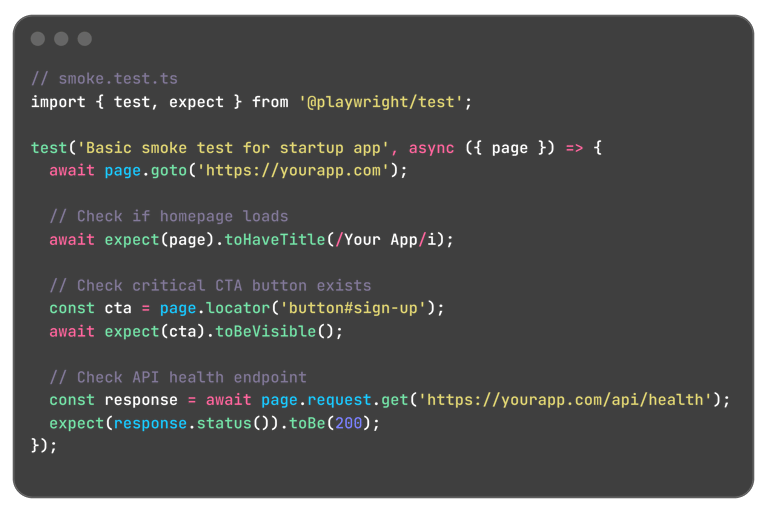
This tiny test alone catches 20–30% of early-stage breaking issues.
How Qanade Can Help
If a startup doesn’t know where to begin, a trusted QA partner like Qanade can help set up a scalable testing approach — without slowing down development or burning budget.
contact@qanade.com
Pune, Maharashta, India.
“Quality is never an accident; it is always the result of intelligent effort.” — John Ruskin


